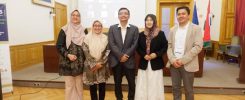
Yogyakarta, February 28, 2026 – The Jusuf Kalla School of Government (JKSG), Universitas Muhammadiyah Yogyakarta (UMY), successfully held its 8th JKSG Webinar Series titled “Lessons Learned from Good Governance Implementation: Perspectives from Malaysia and Indonesia” on Saturday, February 28, 2026, via Zoom. The webinar gathered 67 participants from Indonesia, Malaysia, Bangladesh, Somalia, Nigeria, Pakistan, Thailand, and the Philippines to discuss comparative experiences in implementing good governance principles.
The webinar was officially opened by Prof. Eko Priyo Purnomo, S.IP., M.Res., M.Si., Ph.D., Director of JKSG. In his opening remarks, he emphasized that good governance is not merely a normative concept but a practical framework that requires institutional commitment, administrative reform, and political will. He highlighted the importance of comparative learning between neighboring countries to strengthen transparency, accountability, and effective public service delivery.
The discussion was moderated by Muhammad Zuhdan, S.IP., M.A., Ph.D. (Cand.), Head of the Government Science Program at Universitas AMIKOM Yogyakarta. He is also a Ph.D. Candidate at the Department of Government Affairs and Administration, Universitas Muhammadiyah Yogyakarta, and a scholar at JKSG. He facilitated the session by guiding critical discussion and encouraging participants to actively engage with the speakers.
The first speaker, Dr. Rohana Ahmad, Associate Professor/Senior Lecturer at Universiti Malaysia Terengganu, Malaysia, presented Malaysia’s experience in institutionalizing good governance practices. She explained how governance reforms in Malaysia have focused on strengthening public sector integrity, improving service delivery systems, and enhancing transparency through administrative modernization. She also discussed the role of performance evaluation mechanisms and integrity frameworks in promoting accountability within public institutions. In addition, she highlighted key challenges, including bureaucratic resistance, policy coordination issues, and maintaining public trust amid evolving political dynamics.
The second speaker, Dr. Dyah Estu Kurniawati, M.Si, Lecturer at Universitas Muhammadiyah Malang, Indonesia, presented Indonesia’s approach to good governance implementation in the post-reformasi era. She elaborated on decentralization policies, bureaucratic reform programs, and digital governance initiatives aimed at increasing transparency and public participation. She stressed that while Indonesia has made significant progress in strengthening institutional accountability and public oversight, challenges remain in ensuring policy consistency, reducing corruption risks, and improving coordination between central and local governments.
The webinar was highly interactive. Participants actively raised questions regarding governance effectiveness, comparative administrative reforms, anti-corruption strategies, and the role of digital transformation in strengthening accountability. The diversity of participants enriched the discussion, as attendees shared governance experiences from their respective countries.
The event concluded with reflections on how Malaysia and Indonesia, despite having different political and administrative contexts, face similar structural challenges in implementing good governance. The comparative discussion provided practical insights and encouraged cross-national learning among participants.
Through this 8th edition of its Webinar Series, JKSG reaffirmed its commitment to serving as an academic platform for critical dialogue, regional collaboration, and policy-oriented discussions on governance and public administration. The strong participation and active engagement demonstrated the growing international interest in comparative governance studies.