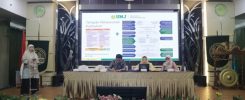
ILIGAN CITY (PIA) — Stakeholders are promoting Islamic microfinance as a solution to financial exclusion in the Philippines, following a capacity-building workshop at Mindanao State University-Iligan Institute of Technology (MSU-IIT).
The Workshop on Developing an Islamic Scheme for Microfinance, held March 31 at MSU-IIT, gathered participants from academia, banking, and the cooperative sector.
The activity was organized by Universitas Muhammadiyah Yogyakarta (UMY), MSU-IIT, and the MSU-IIT National Multi-Purpose Cooperative (NMPC).
Associate Professor Sittie Noffaisah Pasandalan, assistant dean of the College of Arts and Social Sciences at MSU-IIT, stated that limited public awareness continues to hinder the development of Islamic microfinance in the country. She said research engagement could help position it as a financing alternative.
“Students and researchers can study Islamic microfinance and how it can be a potential financial scheme that Filipinos can use. Hopefully, through research, there would be more interest in Islamic microfinance,” she said.
Pasandalan said the group plans to engage with government agencies, such as the Cooperative Development Authority and the Bangko Sentral ng Pilipinas, next year. She added that they also aim to assist cooperatives in developing Islamic microfinance products and services.
From the cooperative sector, MSU-IIT NMPC vice chairperson Dr. David N. Almarez said the cooperative is strengthening efforts to sustain operations and serve members. He said larger cooperatives can provide a wider range of services.
“The cooperative is practicing the same practices that are being done by Islamic financing, but there is a need for adaptation, wherein we are going to join the terminologies of Islamic banking or Islamic financing. It is for the benefit of all the members because the cooperative is owned by its members,” he said.
Professor Rizal Yaya, program coordinator and professor of accountancy at UMY, said Islamic finance is designed to serve low-income individuals and small and medium enterprises while adhering to Islamic law. He said it can address financial exclusion in the country.
He also cited Indonesia, where Islamic banking contributed to economic stability during financial crises.
“Islamic finance will bring better stability to the economy and will also bring a better solution for financial inclusion, especially for the problem of people excluded from banking,” he said.
Jalani M. Ramos, manager of the Al-Amanah Islamic Investment Bank of the Philippines–Iligan City branch, said the bank has nine branches nationwide, including in Iligan, Cotabato, Cagayan de Oro, Marawi, Davao, General Santos, Jolo, Zamboanga, and San Juan City.
He said the bank participates in resource speakerships with government agencies, including the National Commission on Muslim Filipinos, to promote Islamic banking.
“Al-Amanah Islamic Bank, through its charity fund, goes into the community to give charity and then provides Islamic financial literacy to help them learn that, in the Philippines, there’s also an Islamic bank that caters to Islamic finance activities,” he said.
Shari’a lawyer and halal advocate Dr. Leonilo Go Paulin Jr. said awareness remains a challenge, noting that many Filipinos, including Muslims, are more familiar with conventional banking.
“So, my advice is that there must be massive education for the public so that they would understand what Islamic finance is, what Islamic banking is, and what those concepts are, so that both Muslims and non-Muslims would understand and try to help establish more Islamic banking or Islamic finance,” he said.
Participants from the cooperative sector expressed plans to adopt Islamic finance models. MSU-IIT NMPC marketing manager Veronikka Aynne J. Quiamco said the training encouraged them to pursue Islamic financing initiatives.
“On my end, it is very impactful, since we want our cooperative to be the first to have Islamic financing,” she said.
Quiamco said they aim to advance the initiative within the year and propose policies for savings products and other financial services under Islamic financing.
Arien B. Ang-ug, branch manager of the cooperative’s main office, said the workshop clarified how Islamic finance differs from conventional cooperative lending, which focuses on purchasing goods instead of providing cash directly to members. (LELA/PIA-10/Lanao del Norte).